I’ve been in technology for nearly 20 years. Across every role I’ve held, one question has followed me around. How do I make this work better?
I think it started the day my mom bought me a $2,500 computer. I’d been convincing her for months.
The $2,500 computer
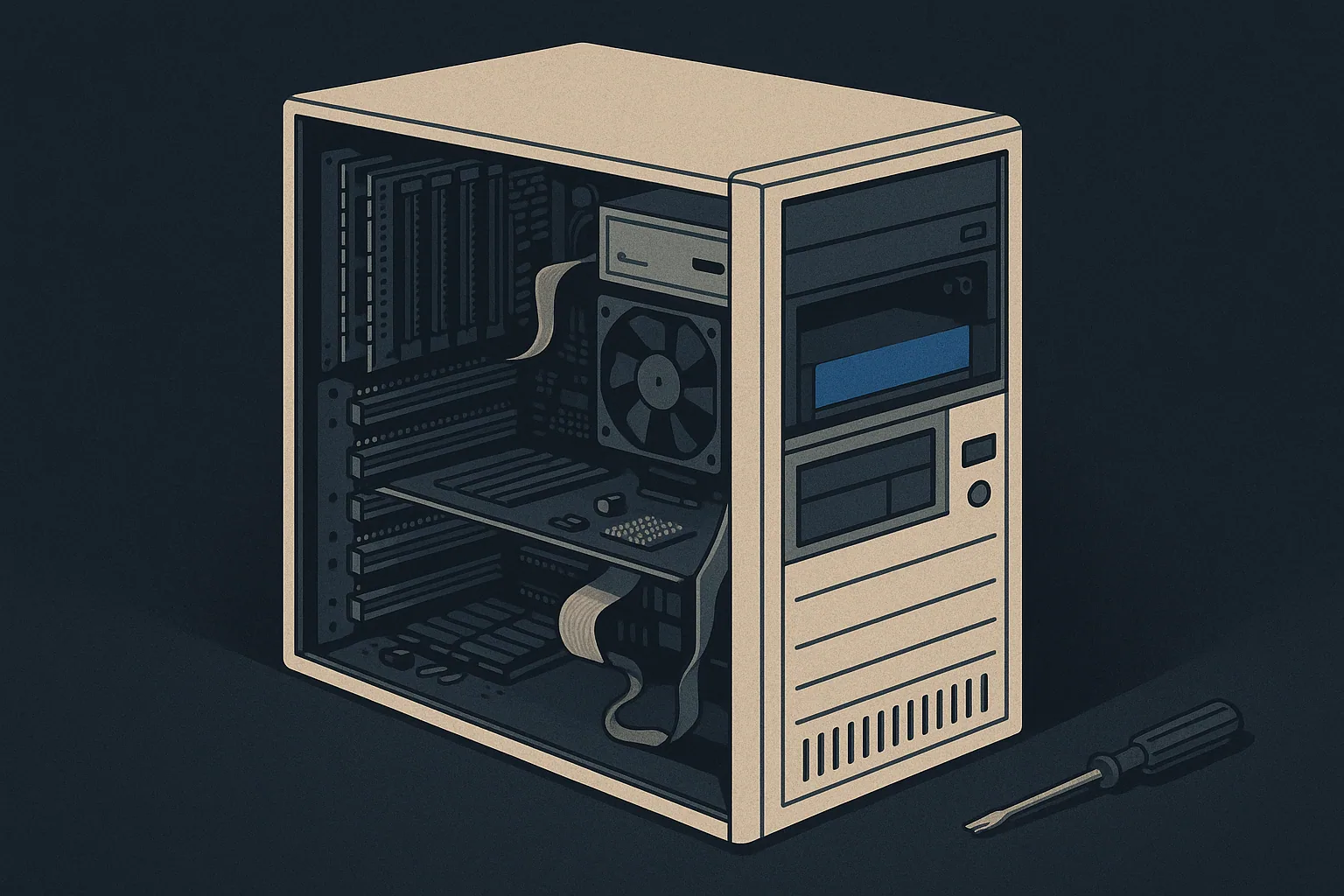
Money was tight at the time, and I still remember the weight of that gift. Six months later, I took it apart.
She was furious. But I wasn’t breaking it. I was curious. Curious about the RAM. Curious about the dial-up modem. Curious about every part inside that case and what each one actually did. The only way to find out was to open it up and look.
I put it back together, and something clicked. Not just the hardware. Something in me. The loop of opening a thing up, seeing how it worked, figuring out how to make it better, and putting it back together in improved shape. That became the way I learned. Still is.
That curiosity turned into money before I realized it could. I fixed computers at people’s houses. I answered tech questions for strangers in retail stores. Eventually it landed me my first real job at a small company running a Mac server and a backup tool called Retrospect. A pizza box server. I’m not even sure they make those anymore.
Retrospect is what got me my next job, at an ad agency. Funny how a single piece of niche software can redirect a career.
The decade in the middle
The ad agency was where I learned fixing computers can get lonely. I’d sit in a cold server room watching YouTube between tickets. My manager noticed I could do more than keep the printers alive. I could talk to clients. So he moved me into project management.
Over the next decade I worked across a handful of companies in different industries, on different stacks, with different teams. I got to see how enterprise works from the inside. How big infrastructure actually runs. How ecommerce platforms hold together at scale. How web servers talk to each other. How networking stitches it all together. I worked across enough teams to understand where the real friction sits in a business, which is almost never the thing people think it is.
I used to call myself a translator. One half of my day was spent talking to engineers in their dialect of technical English. The other half was spent turning that into a different dialect of technical English for the people who ran the business. Same language on paper. Completely different grammar in practice. I got good at moving between them, and that skill ended up being more valuable than any specific technology I learned.
The friction, over and over, was the same thing in different outfits. A report lived in one system. The customer record lived in another. The billing data was in a third. Getting those three to agree on a single version of the truth required a person, usually several people, stitching spreadsheets together by hand every Monday.
I didn’t have a name for it yet. But I was starting to notice that the hardest problems in a business weren’t about the software being bad. They were about the data being stuck.
The startup shift
After a decade of seeing how enterprise runs, I moved into startups. The change was jarring in the best way.
In enterprise, process is the water you swim in. Everything has a workflow, a form, a three tiered approval chain. In a startup, process doesn’t exist yet. You have to build it. And you have to build it while doing six other jobs at once, because that’s what wearing many hats actually means.
This is where I learned the skills I use most today. How to look at a messy workflow and see what’s actually broken. How to pick the right tool, and more importantly, how to recognize when no existing tool is the right one. How to decide whether to buy, build, or duct tape, and how to know when you’ve gotten the answer wrong.
Around 2017, a new option showed up. No code and low code platforms got good enough to take seriously. Airtable, Zapier, the early wave of tools that let you stand up real software without writing real code. I leaned in hard. For a certain class of problem, it was a revelation. You could centralize data, wire up automations, and ship something useful in a week that would have taken a team three months a decade earlier.
But the ceiling was real, and it showed up in places I didn’t expect.
The first was pricing. Airtable was easy to build on. I could spin up a working database in an afternoon, wire up an interface that let anyone view the data on a free account, and have a real piece of software running by the end of the week. The problem came the moment someone needed to edit. Editing required a seat. Seats were expensive. A team of fifteen people who each needed to update a single field became a line item that could swallow a small business’s entire tooling budget.
The second was the tool itself. Airtable, in my eyes, is easy. In most people’s eyes, it’s a spreadsheet with too many opinions. There’s a real learning curve to using it properly, and most teams never clear it. You end up with one or two people who actually understand the tool, and everyone else bouncing off it and asking those people to do things for them. That’s not centralized data. That’s a bottleneck with a pretty interface.
The third was the one that stuck with me. Technically, the data in Airtable was free. The API was there. You could pull it, push it, move it, reshape it. But every time I wanted to do any of that, it was an afternoon of work. Set up the connection. Write the automation. Handle the edge cases. Keep it running. The data was free in theory, but freeing it cost me an afternoon every single time.
I hit variations of this across other platforms. Seat limits. Feature gates. Integrations that only worked in one direction. You could always get data in. Getting it back out, or letting the right people touch it, was the expensive part. Sometimes in money. Sometimes in time. Usually both.
That was the lesson. The tools weren’t really the problem. The cost of freeing my data was.
Then AI showed up
A few years ago, generative AI landed in everyone’s lap, and that old curiosity lit up again.
I didn’t have a grand plan for it. I used it. I leveraged it. At first I didn’t really know how to apply it to my actual work beyond checking grammar and rewording emails, which is probably how most people started. But I kept poking at it. That’s the pattern. I got curious and I learned.
I asked it questions about things I already knew. How to make my Airtable setups better. How to clean up scripts I’d been running for years. How to think about problems I’d been solving the same way since 2017. I wasn’t asking it to do the work. I was asking it to show me the gaps in how I’d been doing the work.
For a while it felt like a lot. New paradigm every week. New workflow to learn. New rough edges to work around. I waited. I watched. I kept tinkering. And sometime along the way, the shape of it became obvious.
The thing that used to take me four hours of connector glue and automation plumbing could now be built in twenty minutes. The gap between “I wish my data could do this” and “my data does this” collapsed. The ceiling I’d been hitting for a decade wasn’t a ceiling anymore.
What it actually comes down to
Twenty years of different jobs and different companies and different tools, and all of it lands on the same idea.
The hardest thing in software is freedom with your data.
Not the best dashboard. Not the prettiest interface. Not the cleverest feature. Freedom. The ability to put data in, retrieve it, move it, reshape it, and act on it without paying a tax every time you want to use what’s already yours.
Data is where the detail of your business lives. Every real process leaves a trail in the data. Every decision worth improving is visible there. Every insight worth chasing is waiting there. The beautiful software I’ve admired always has this in common. Someone owned the data, and built an opinionated view on top of it. The opinion is what you see. The data is what makes the opinion possible.
When your data is free, the question stops being “what can this tool let me do?” and starts being “what do I actually want to build?” That’s a completely different way to think about software, and it’s the one most businesses have never been able to afford until now.
When your data isn’t free, you spend your afternoons renting keys to your own business and calling it a tech stack.
Who gets to build the view
The part of this I find most interesting is what happens to the people in the middle.
Building an opinionated view used to take a team. Someone had to understand the business well enough to know what mattered. Someone had to understand the data well enough to get it out. Someone had to understand design well enough to put it in front of humans. Someone had to understand engineering well enough to hold the whole thing together. Four specialists, minimum. A lot of meetings. A lot of budget.
That whole stack is collapsing into a conversation.
On one side, AI is now capable of looking at the data and proposing a view. What matters. What’s changing. What’s worth flagging. It doesn’t have the business context out of the gate, but it can analyze faster and more patiently than any analyst.
On the other side, the business owner knows exactly what they want to see. They always did. They just never had the vocabulary or the time or the team to describe it into a real interface.
The interesting work happens in the negotiation between those two sides. The owner says “I want to see this.” The AI responds with “here’s what I can show you from the data you have, and here’s what I’d need to show you the rest.” The owner adjusts. The AI adjusts. That back and forth used to be three months of discovery meetings and half a dozen Figma mockups. Now it’s an afternoon.
That negotiation is where the opinionated view actually gets built. And for the first time, the person with the opinion and the person building the view can be the same person.
Back to the kid with the screwdriver
I keep coming back to that kid sitting on the floor with a Windows 98 tower open in front of him.
He wasn’t breaking it. He was trying to make it better. Figure out what was inside. Figure out what could be upgraded. Figure out the smallest change that would make the whole thing run faster. Every job since has been the same instinct applied to something a little bigger. A printer. A server. A workflow. An agency. A startup. A data pipeline. A business.
The size of what you can take apart and reassemble keeps growing. For the first time in 20 years, the thing on the table is the whole software stack. Even the companies that built the modern SaaS playbook see it coming. When Marc Benioff signals Salesforce is moving toward a fully headless architecture, that’s a tell. The direction the platforms that matter are moving is toward freedom, not away from it.
And the question that decides whether you get to do anything interesting with any of it is older and simpler than any of the AI tooling.
Is your data free?
Not locked behind a seat count. Not buried inside a tool only two people understand. Not technically accessible but practically an afternoon away. Free. Reachable. Yours to shape.
If the answer is yes, the possibilities in front of you right now are genuinely exciting. If the answer is anything else, that’s the problem worth solving first. Everything else waits on it.
The kid with the screwdriver already figured that out. He just didn’t have the words for it yet.